Most business websites follow the same formula: a homepage, a few service pages, a contact form, and maybe a blog nobody reads. The visitor arrives, scans for three seconds, and leaves. The business never finds out what they wanted or how close they were to buying.
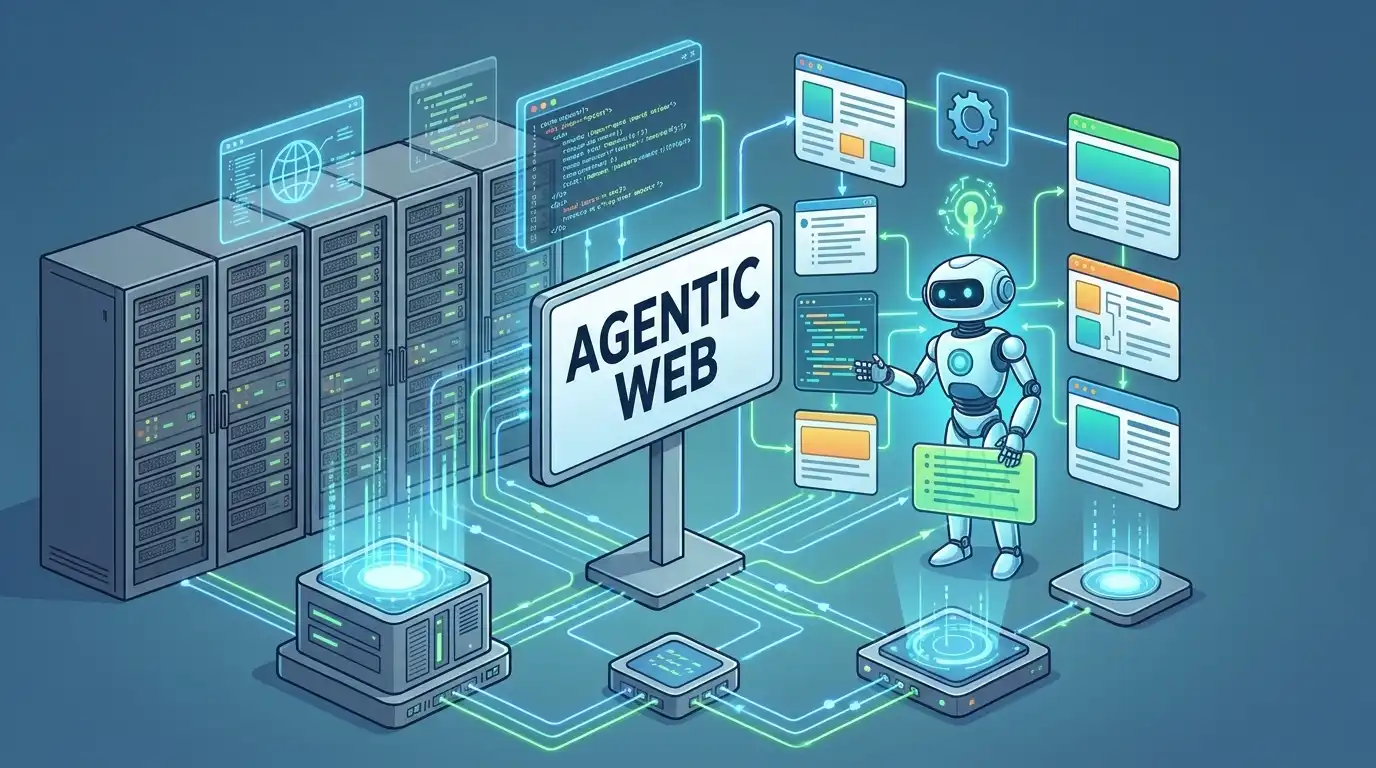
An agentic web flips that model. Instead of displaying information and waiting, the site behaves as an agent: it converses in real time, acts on live business knowledge, connects with other systems and agents, and keeps itself current. This is not an incremental improvement to web design — it is a structural change in what a website is.
Key Takeaways
A quick look at what this article covers and why it matters.
From Brochure to Agent: Three Eras of the Web
The web has gone through two clear phases, and is now entering a third.
The first phase was informational. Businesses put up digital brochures — static HTML pages with company descriptions, phone numbers, and maybe a map. The goal was presence: exist online so people can find you.
The second phase was interactive. WordPress, e-commerce platforms, landing pages, forms, analytics, A/B testing. The goal shifted to conversion: get visitors to do something measurable. This is where most businesses still operate today.
The third phase is agentic. The site is no longer a collection of pages waiting to be browsed. It is an autonomous system that understands the business, interprets each visitor's intent, and responds accordingly — in natural language, in real time, without requiring the visitor to navigate menus or fill out forms.
| Era | Role of the Site | How the Visitor Interacts | Conversion Mechanism |
|---|---|---|---|
| Informational (1995–2005) | Digital brochure | Reads pages, calls a phone number | Offline follow-up |
| Interactive (2005–2020) | Conversion machine | Clicks, fills forms, browses catalogs | Forms, CTAs, funnels |
| Agentic (2020s–) | Autonomous acquisition agent | Converses, asks, gets answers | Conversation-native capture |
Each phase did not eliminate the previous one — it absorbed it. An agentic web still has pages and structured content, but the primary interaction layer is the agent.
What Exactly Is an Agentic Web
An agentic web is a website where the protagonist is not static content but an AI-powered agent that knows the business inside out and acts on that knowledge in every visitor interaction.
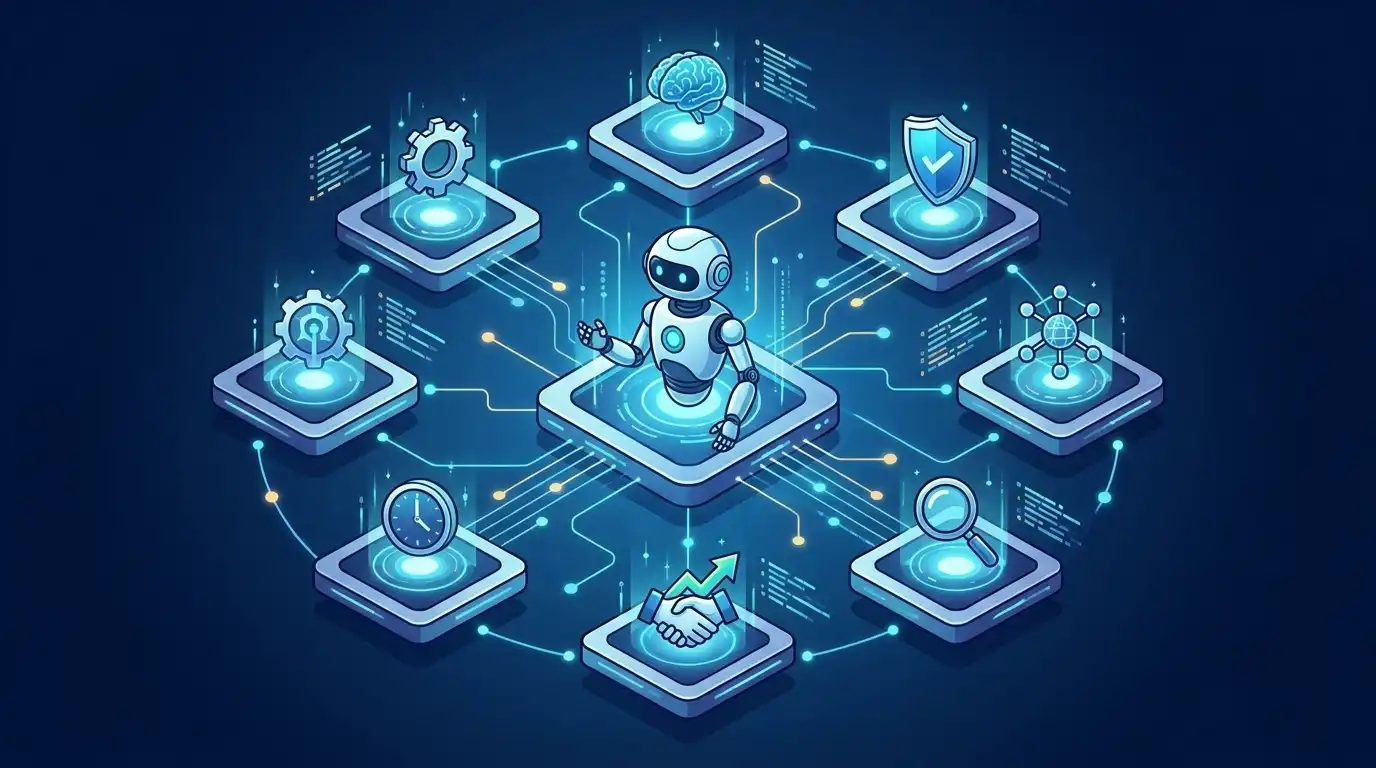
Toward visitors it operates across three modes — informative (answering from site content and live context), navigation (directing the visitor to what they need as an action, not a suggestion), and acquisition (capturing intent conversationally). But it also faces outward and inward: it exposes a machine-readable layer other agents can query, and an integration layer that keeps it synchronized with the business's own systems.
The key distinction: the entire site is designed as an agent. Not a page with a widget bolted on. The architecture — content, knowledge base, conversational layer, lead capture, and measurement — is built as a single system where every component feeds the others.
Why Does the Passive Web No Longer Work
The numbers tell a clear story. According to Similarweb and SparkToro data, roughly two thirds of Google searches now end without a click to any website. When AI Overviews appear on a search result, the zero-click rate climbs even higher.
- Zero-click search rate (2026)
- ~65%
- Cross-industry median bounce rate
- 47.4%
- AI Overview zero-click rate
- 83%
- AI Mode zero-click rate
- 93%
This means the majority of potential customers never reach your site at all. And among those who do, nearly half leave after viewing a single page without taking any action — the cross-industry median bounce rate sits at 47.4% in 2026.
A passive website — one that shows information and waits for the visitor to act — is built for an internet that no longer exists. The visitors who still arrive carry higher intent than ever before, precisely because the low-intent queries get resolved before they even click. Wasting that high-intent traffic on a static page with a phone number and a contact form is a business problem, not a design problem.
How an Agentic Web Captures Demand
The mechanism is straightforward: instead of forcing the visitor through a predetermined funnel, the agent meets them where they are.
A visitor lands on a dental clinic's site at 11 PM wondering whether their insurance covers implants. On a conventional site, they see a phone number, an email address, and maybe a FAQ page. They leave. On an agentic web, the agent answers the insurance question, asks about the specific treatment they need, and books a consultation — all within the same conversation.
The 2026 AI Search Benchmark Report from Opollo found that AI-referred visitors converted at roughly five times the rate of traditional organic traffic. The pattern is consistent across industries: visitors arriving through AI search engines have already described their problem, received a synthesized answer, and chosen to click through. They are pre-qualified before they reach your site.
AI accounted for just 4% of sessions but 19% of the qualified inbound pipeline. AI traffic volume is still smaller. Its commercial impact is not.
An agentic web is built to serve exactly this kind of visitor — one who arrives with a specific question and expects a specific answer, not a navigation menu.
What Makes This Different From Adding a Conversational Tool
This is the most common misunderstanding. A conversational interface on top of a conventional site does not make it agentic. The difference is structural, not cosmetic.
A conventional site with a conversational widget still relies on pages to do the selling. The widget is an add-on — usually operating in a sidebar, answering generic questions, and escalating to a human the moment the query gets specific. The content, the navigation, and the conversion mechanism are all still page-based. The widget is decorative automation.
An agentic web inverts that hierarchy. The agent is the primary interface. Content exists to feed the agent's knowledge, not to be browsed directly. Lead capture happens inside the conversation flow, not through a form interruption. Navigation is an action the agent performs, not a menu the visitor clicks.
| Dimension | Conventional Site + Widget | Agentic Web |
|---|---|---|
| Primary interface | Pages and menus | The agent |
| Content role | Displayed for the visitor to read | Knowledge base for the agent |
| Lead capture | Forms, modals, CTAs | Conversation-native |
| Qualification | Manual or rule-based | Real-time, intent-driven |
| Visitor experience | Browse → find → submit | Ask → get answered → convert |
Gartner projects that by 2028, 60% of brands will use agentic AI to deliver one-to-one interactions — replacing channel-based marketing with autonomous, personalized engagement. The shift is not about adding AI to what exists. It is about redesigning the interface around what AI makes possible.
Beyond the Visitor: The Web of Agents
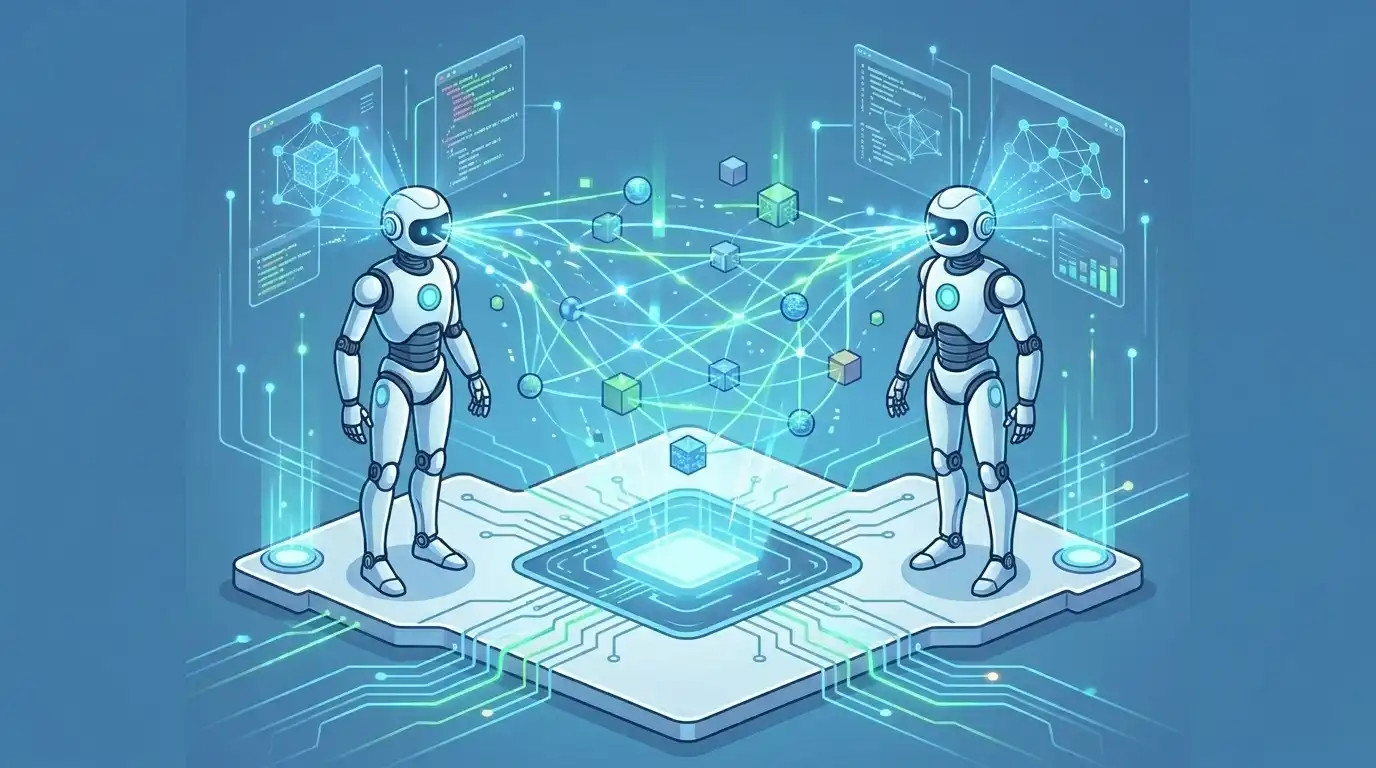
The visitor-facing view is only half the picture. The broader shift is that the web itself is becoming machine-to-machine infrastructure — a mesh of autonomous agents that interpret goals and transact with each other over open protocols rather than rendering pages for humans to read.
A site built as an agent would be a node in that mesh. It would expose clean, structured data that an external agent — from another company or acting for a buyer — could query and act on directly: checking specifications, compatibility, or availability and completing a transaction without a human in the loop. The relevant standards are already consolidating, with MCP for tool access and A2A for agent-to-agent coordination, and adoption spanning a growing number of companies.
This is the dimension a conversational widget cannot reach. A widget serves people in a sidebar; a node serves other software. As human browsing declines, the businesses whose sites can be read and operated by other agents would capture interactions that never involve a person at all — while a passive page remains invisible to that traffic entirely.
Who Benefits First and Why
Not every business benefits equally from an agentic web. The highest impact comes where three conditions converge: the buyer needs to trust before purchasing, the buying process involves questions, and speed of response directly affects conversion.
Local businesses with appointments — clinics, law firms, physiotherapists, salons — share a common pattern. The customer has a need, searches locally, and needs confidence before booking. The agent handles the triage step that today gets lost between the search result and the phone call nobody makes.
B2B and industrial companies deal with buyers who research for weeks before contacting sales. The agent absorbs that research phase entirely — answering product specs, compatibility questions, and use-case queries — and hands off a lead that already knows what they want.
Consultative services — insurance, finance, education — sell products that the customer will not buy without understanding first. The agent delivers that personalized advisory that today only happens if a human is available at the right moment.
A fourth pattern is structural rather than conversational: manufacturers and distributors whose value lies in being queryable by other companies' agents.
- Conversational funnels vs. web forms
- 2.4x higher conversion
- Lead qualification time with automated workflows
- −61%
- Revenue uplift with AI agent deployment
- 7–25%
The common thread is that these businesses lose customers not because their product is wrong, but because the path from interest to action has too much friction. An agentic web eliminates that friction at the point where it matters most — the first interaction.
Frequently Asked Questions
Is an agentic web just a landing page with a chatbot?
No. A conventional landing page with a conversational widget still relies on static content to sell and uses the widget as a secondary support channel. An agentic web is designed from the ground up around the agent — content, navigation, lead capture, and measurement all feed through the conversational layer as the primary interface.
Does an agentic web still need traditional SEO?
Yes, but the optimization strategy expands. Beyond indexing pages for Google, an agentic web is optimized for AISEO — making the site quotable by AI answer engines like ChatGPT, Perplexity, and Google's AI Overviews. Structured data, topical authority, and self-contained answers become critical because they determine whether AI systems cite your business.
How would it connect to a business's other systems?
Through integration layers and standard protocols. Such a site would draw live data from the CRM and ERP so answers match current availability and pricing, and would expose structured data that external agents can query — making it interoperable rather than isolated.
What makes it a ‘node’ in a web of agents?
Beyond serving people, it would publish a machine-readable interface other software agents can read and transact with, under emerging standards such as MCP and A2A. A conventional page offers nothing an external agent can act on; an agentic web is built to be operated by other agents.
Can an agentic web work for e-commerce?
Yes. In e-commerce, the agent recommends products based on what the visitor describes needing — not based on filter algorithms. It handles objections, compares options, and can close the conversion within the conversation itself, acting as a guided selling assistant that operates around the clock.