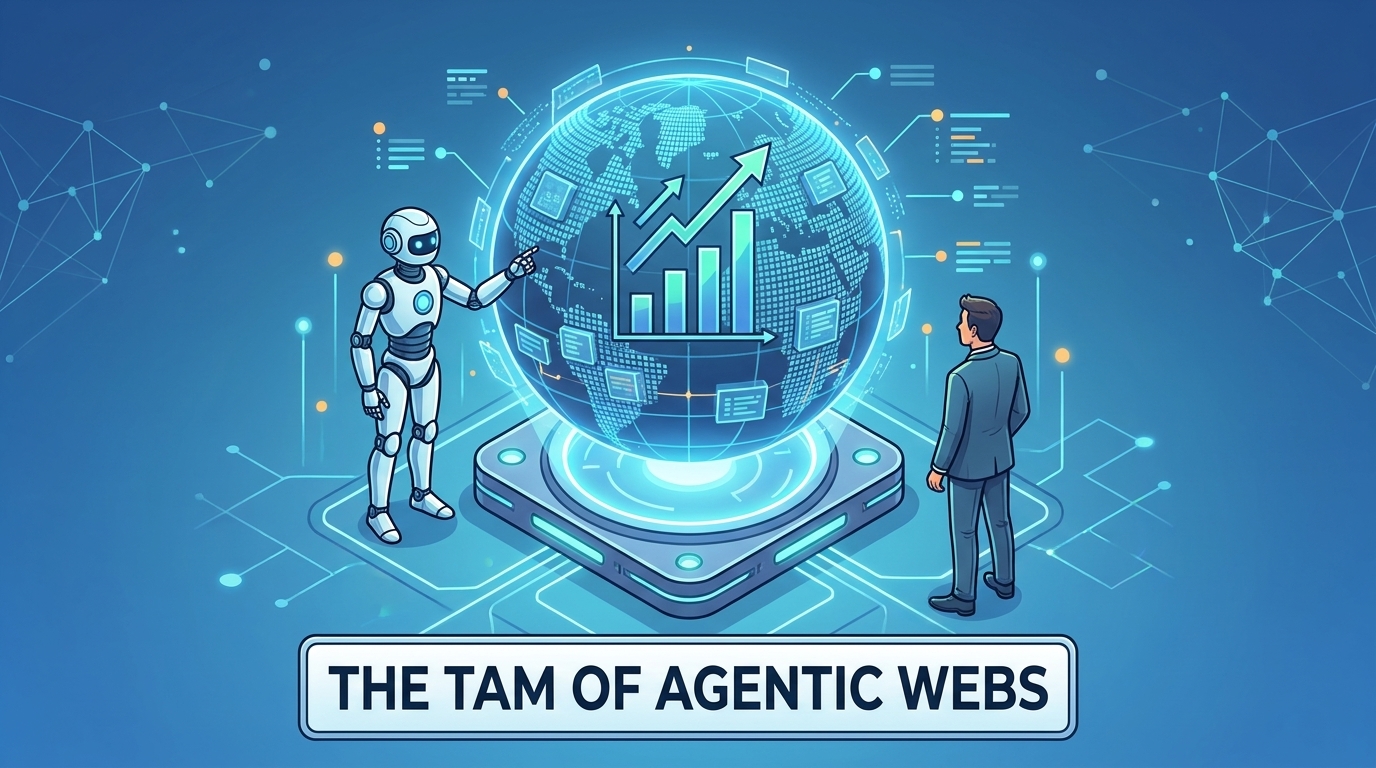
When a product term becomes a category name, it stops describing one vendor's offering and starts defining a budget line that buyers expect to fill. If "agentic web" follows that path (the way "CRM" or "e-commerce platform" once did) the relevant question is no longer what a single site costs, but how large the category it names could become.
The credible answer: the category "Agentic Webs" could mean $40B–$80B annual software-and-services category by the early 2030s, with upside above $100B if websites become the default transaction and interoperability layer for AI agents. That estimate comes from sizing the adjacent markets an agentic web would absorb or connect, not from a number invented top-down.
Key Takeaways
The estimate is built bottom-up from markets that already exist and are already being reorganized by autonomous agents.
Why a Category Name Changes the Math
Market sizing depends heavily on where you draw the boundary. A "website with an AI assistant" is a feature inside an existing budget; a recognized product category is a line item buyers allocate to deliberately. The shift from the first framing to the second is what moves a TAM from hundreds of millions into tens of billions.
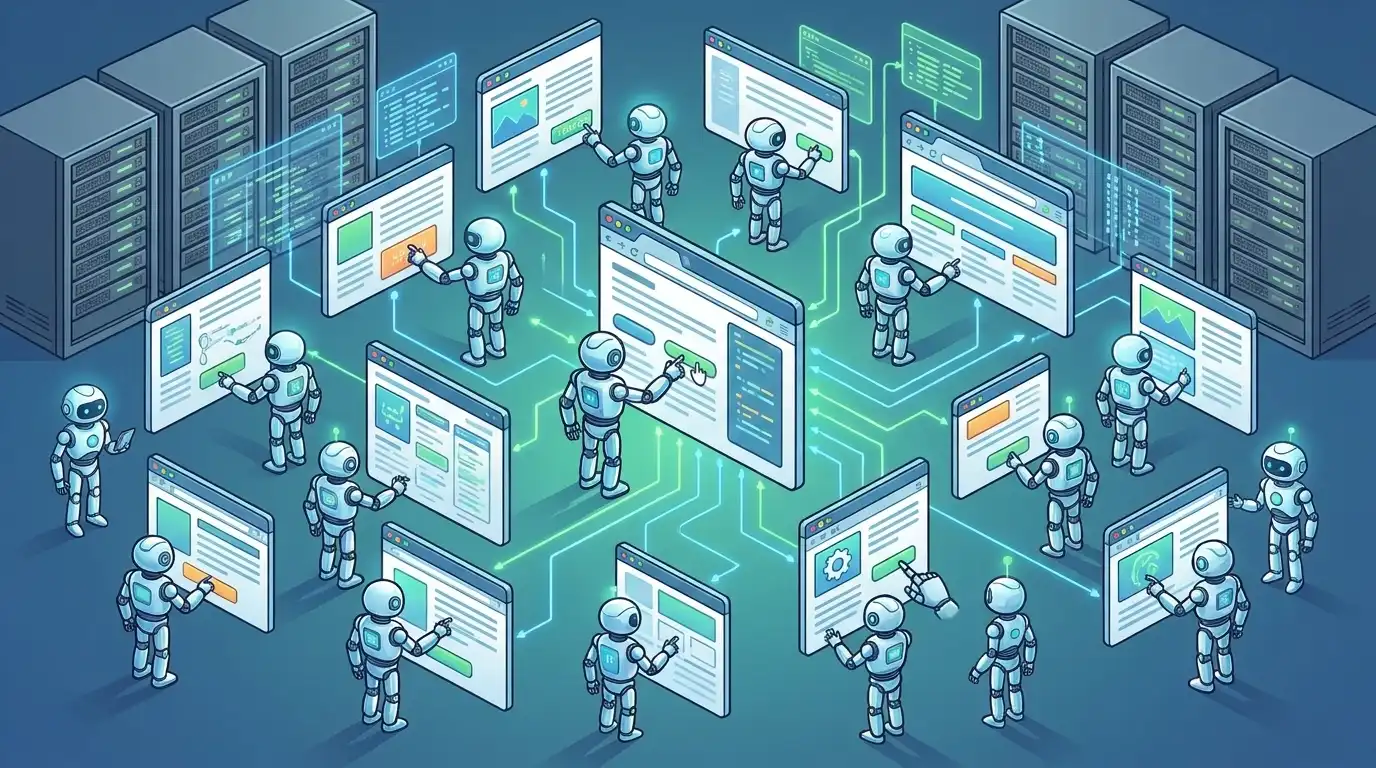
The agentic web, as infrastructure, is not a single tool. It is a layer that spans website creation, AI agents, conversational interfaces, commerce software, CRM, marketing automation, customer support, and the emerging interoperability protocols. Each of those is an established market with its own spending, and an agentic web touches all of them at once.
That breadth is the reason the number is large. The category would not invent demand from scratch; it would consolidate demand currently spread across a chain of separate providers into a single architecture, exactly the fragmentation collapse that defines the product.
The Adjacent Markets That Set the Floor
The starting point is the markets an agentic web would draw from. Web development alone is valued at $87.75 billion in 2026, projected to reach $134.17 billion by 2031, and that is just the build-and-maintain layer.
The AI-agent layer is forming far faster. Grand View Research estimates the AI agents market at $10.91 billion in 2026, reaching $182.97 billion by 2033 at a 49.6% CAGR, a curve that shows where software budgets are moving. CRM, the largest enterprise-software category, sits even higher.
- Web development (2026)
- $87.75B
- AI agents (2026 → 2033)
- $10.91B → $182.97B
- CRM software (2026)
- $126.17B
- Conversational AI (2030 est.)
- ~$41B
CRM is worth $126.17 billion in 2026, growing toward $320.99 billion by 2034, while conversational AI is projected to reach about $41 billion by 2030. An agentic web does not own these markets, but it sits adjacent to all of them, which is why the category's ceiling is measured against their combined scale, not against website builders alone.
The Base Case: $40B–$80B Per Year
The base case rests on the installed base. There are roughly 200 million active websites globally, but only a fraction are serious commercial sites able to pay for agentic functionality. The realistic buyer pool is the commercial subset: small and mid-market businesses plus enterprises with a genuine acquisition channel to run.
If 20–40 million commercial sites eventually become buyers, at an average annual revenue per customer ranging from roughly $1,000–$3,000 for SMEs and far higher for mid-market and enterprise contracts, the arithmetic supports $40B–$80B in annual category revenue by the early 2030s.
💡 Expert note: A site bought as a one-time build is a low-ARPU asset; a site sold as a managed acquisition channel (agent, content, leads, and measurement in one funnel) is recurring revenue, which is what carries the per-customer figures above.
That base case assumes the agentic web means an AI-native site with embedded agents that qualify and convert, real-time personalization, CRM and calendar integration, a closed-loop content engine, recommendation, analytics, and human handoff. It is a recognized SME and mid-market product category; substantial, but still bounded by human-facing demand.
The Upside: Websites as Transaction Endpoints
The larger number depends on a different role for the website. If agentic webs become the infrastructure for agentic commerce, the site is no longer a marketing asset: it becomes a transaction endpoint that other AI agents query, negotiate with, and buy from directly.
In that scenario, businesses pay not only for the human-facing agent layer but for agent-readable product and service feeds, agent-to-agent coordination, verified agent identity, permissions, AI checkout, quote generation, and analytics on machine-originated demand. The category would then capture budget from web development, commerce software, CRM, support automation, and agent infrastructure simultaneously, which is where a long-term TAM above $100B becomes plausible.
The direction is already visible in the commerce numbers. Morgan Stanley estimates agentic shoppers could reach $190 billion to $385 billion in US e-commerce spending by 2030, and Gartner projects that by 2028, 90% of B2B buying will be mediated by AI agents. A business without an agent-readable layer cannot participate in that flow.
What the Category Replaces, and What It Doesn't
The strategic insight is that agentic webs would not replace websites. They would upgrade the economic role of the website. The site has already passed through three jobs: it was a brochure, then a lead-generation funnel, then an e-commerce storefront. The next version is the website as an autonomous business interface for both humans and AI agents.
This matters for sizing because each prior shift expanded, not shrank, what a website was worth to a business. A brochure justified a few hundred dollars; a storefront justified a percentage of revenue. An interface that converts human visitors and transacts with external agents is worth more again, which is why the TAM compounds rather than substitutes.
The protocol foundation makes the upside credible rather than speculative. MCP is now under the Linux Foundation, A2A has broad adoption, and a three-layer stack of MCP, A2A, and WebMCP is consolidating as the reference architecture. The aggressive case is contingent on that adoption becoming default — but the rails are being laid now, not theorized.
Frequently Asked Questions
What is the TAM of "agentic webs" as a product category?
The base case is $40B–$80B in annual software-and-services revenue by the early 2030s, with long-term upside above $100B if websites become the standard transaction and interoperability layer for AI agents. The figure is built from adjacent markets rather than projected top-down.
How is the agentic web TAM calculated?
By sizing the markets an agentic web would absorb or connect: web development, AI agents, conversational AI, CRM, commerce software, and modeling a realistic buyer pool of 20–40 million commercial websites at an average annual revenue per customer of roughly $1,000–$3,000 for SMEs, plus higher mid-market and enterprise contracts.
Why is the agentic web category so large?
Because it sits at the intersection of several established markets rather than carving out a niche. Web development is worth about $87.75 billion in 2026 and CRM about $126.17 billion, so a layer that consolidates spend across both inherits a large ceiling.
What drives the upside above $100B?
Machine-to-machine demand. If websites become transaction endpoints that external AI agents query and buy from, the category captures budget for agent-readable feeds, agent-to-agent coordination, identity, AI checkout, and machine-demand analytics, on top of the human-facing layer.
Does an agentic web replace the traditional website?
No. It upgrades the website's economic role rather than removing it. The site evolves from brochure, to lead funnel, to storefront, to an autonomous interface that serves human visitors and transacts with AI agents: each step adding value rather than substituting the last.