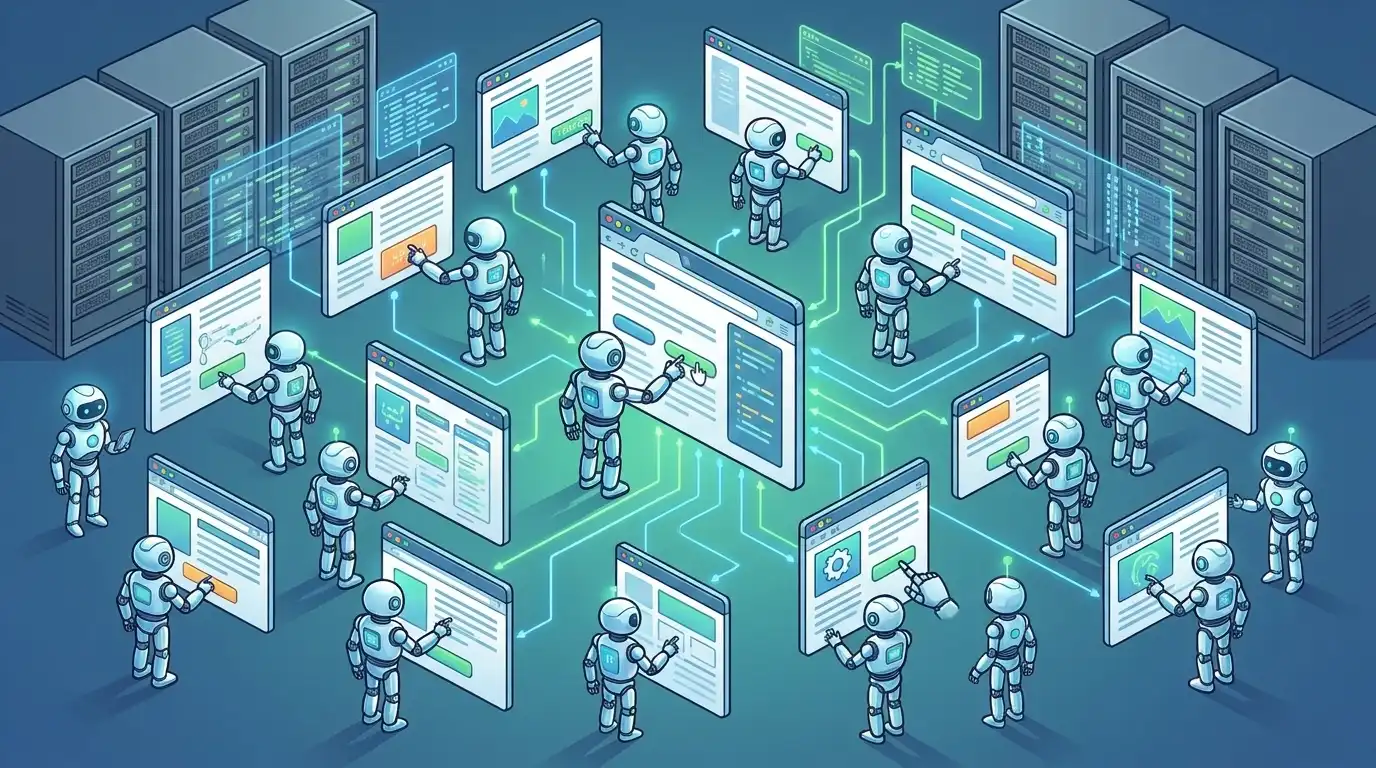
Human browsing is declining, and the web is becoming something people no longer read directly. Increasingly, the visitor arriving at a site is not a person scrolling a page but an autonomous agent acting on someone's behalf. When that happens, a visual layout designed for human eyes stops being an asset and becomes a barrier.
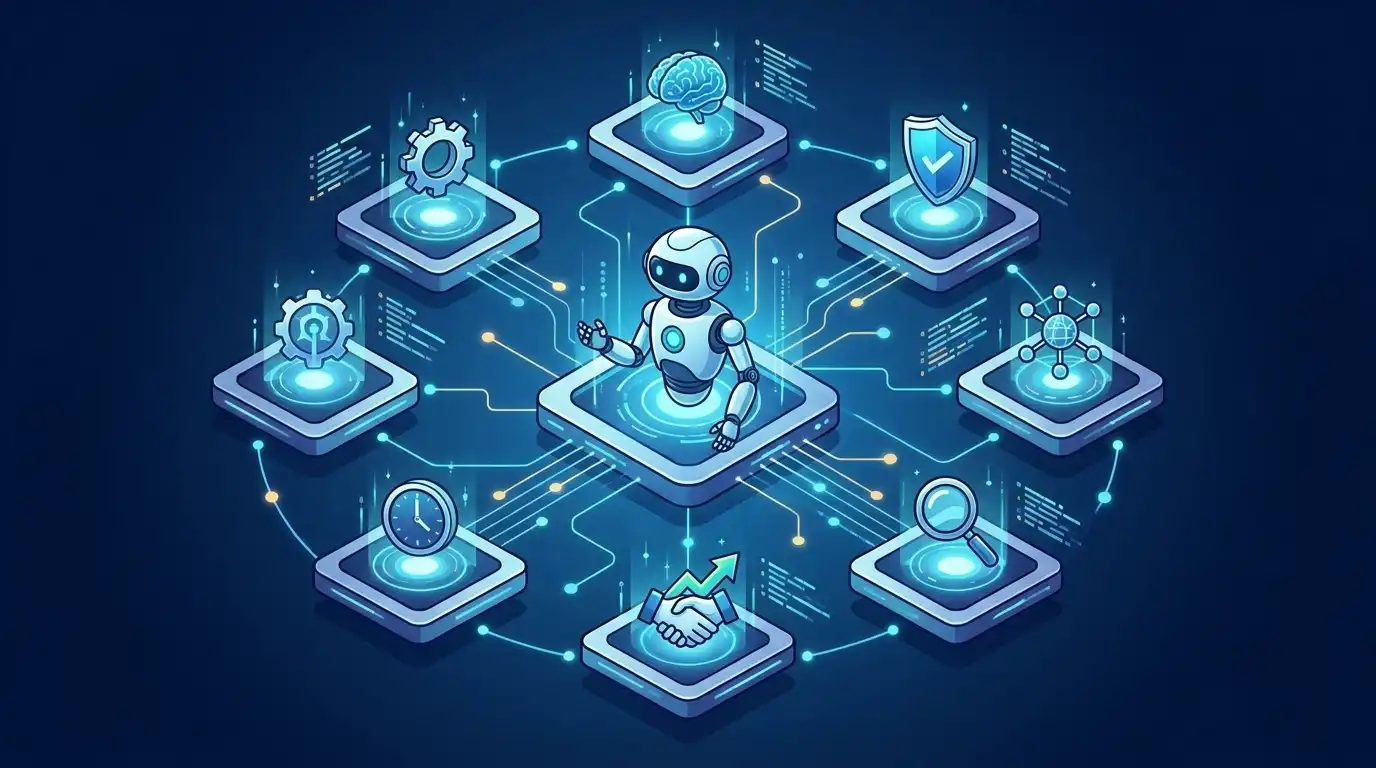
The shift is structural, not cosmetic. The internet is moving from a collection of pages that are read and browsed to a mesh of agents that interpret goals, make decisions, and transact with each other. Those agents coordinate through open protocols: MCP, A2A, and NANDA, and the web underneath them becomes machine-to-machine infrastructure.
This article explains what the agent-to-agent (A2A) economy is, why it changes who your real visitors are, and why a website now needs to behave as a protocol rather than a user interface.
From a Web You Read to a Web That Transacts
The traditional web was built around a single assumption: a human would look at a screen, read content, and act on it. Every menu, form, and layout exists to guide a pair of human eyes toward a decision. That model worked while people were the ones doing the browsing.
That assumption is breaking. The "agentic web" names a new phase of the internet where autonomous AI agents act on behalf of users instead of users navigating page by page. The interaction is no longer person-to-page; it is goal-to-system.
In this model, value is not created by holding a user on a page. It is created by resolving a goal — and increasingly the entity carrying that goal is software, not a person.
The A2A Economy: Software Buying From Software
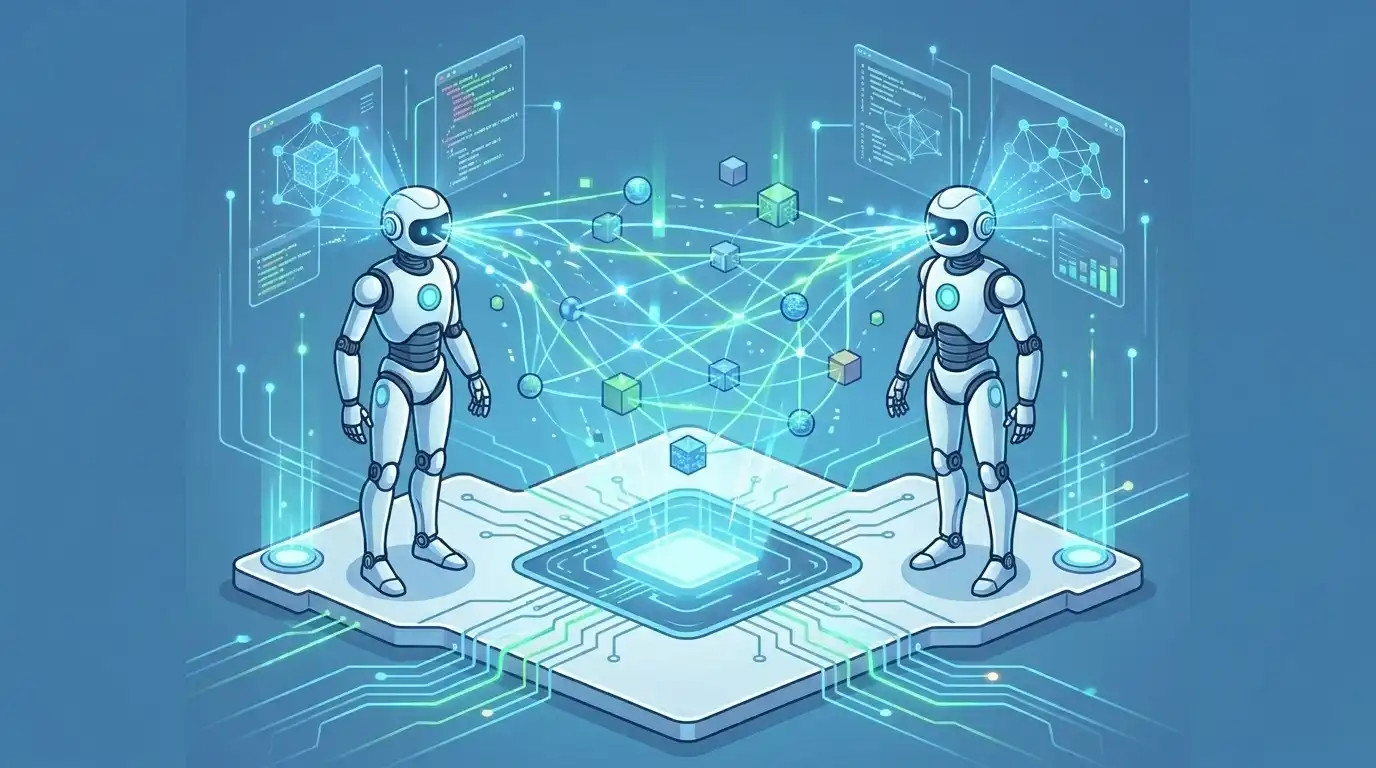
Agent-to-agent commerce means one company's agent talks directly to another company's agent. A buyer's agent searches for a component, queries specifications and stock, confirms compatibility, and closes the transaction — machine to machine, with no human in the loop and no page ever rendered for human eyes.
This is what the Agent2Agent protocol was built to standardize: a common way for agents to discover each other's capabilities, exchange information securely, and coordinate tasks across vendors and frameworks. Crucially, A2A connects agents to other agents, while MCP connects agents to tools and data — they are complementary, not competing.
The reference stack has settled into three layers, and conflating them is the most common source of confusion.
| Layer | What it coordinates | Role in the agentic web |
|---|---|---|
| MCP | Agent ↔ tools and data sources | Lets an agent invoke functions, query a catalog, or read business documents |
| A2A | Agent ↔ agent | Lets a buyer's agent and a seller's agent negotiate and transact directly |
| WebMCP | Agent ↔ web | Gives agents structured access to web resources, not human layouts |
The practical upshot is that an agentic web becomes a real operational node inside an agent ecosystem, rather than an isolated silo that only humans can reach.
Why a Website Now Needs to Be a Protocol, Not a UI
A user interface is a presentation layer — it arranges information for a person to interpret. A protocol is a contract — it specifies how two systems exchange structured data and execute actions reliably. The distinction matters because the agentic web stops being a visual layout for people and becomes a machine-readable environment designed so that external agents can interpret and transact directly.
An agentic web is built for that world. It exposes clean, structured data that an external agent can query, and it operates under the protocols already consolidating as the standard — MCP for tool access and A2A for agent-to-agent coordination.
The economic logic is blunt. A business that offers no agent-readable layer loses share to the one that lets a visiting agent resolve its query or close a transaction instantly, without human friction.
A2A empowers developers to build agents that seamlessly interoperate, regardless of platform, vendor or framework.
Standardization Is What Makes A2A Real
A2A would be a thought experiment if the underlying protocols were fragmented. They are not. According to the Model Context Protocol project, MCP reached over 97 million monthly SDK downloads and 10,000 active servers within its first year, before being donated to the Agentic AI Foundation under the Linux Foundation in December 2025.
On the coordination side, Google launched A2A in April 2025 with more than 50 founding partners, and after the protocol moved to the Linux Foundation in June 2025 that support grew to more than 100 technology companies. Both protocols now sit under neutral, vendor-agnostic governance — the same stewardship model behind projects like Kubernetes.
Standardization is the difference between agents that can only talk inside one vendor's walled garden and agents that can transact across the open web. The second is the one the A2A economy depends on.
- Protocol layers
- MCP (tools), A2A (agent-to-agent), WebMCP (web access)
- MCP monthly SDK downloads
- 97 million+
- MCP active servers
- 10,000+
- A2A launch partners (April 2025)
- 50+
- A2A partners after Linux Foundation move
- 100+
- Governance
- MCP and A2A both under the Linux Foundation
What This Looks Like for a Manufacturer or Distributor
The clearest near-term case is the inert catalog-website. Many manufacturers and distributors delegate all demand to a sales network or trade shows, with a site that only displays a catalog and no organic presence at all.
In an A2A world, that catalog stops being a storefront for humans. When another company's agent searches for a component, the agentic web answers with specifications, compatibility, and stock — pulled live from the ERP — and closes the transaction machine to machine.
The platform layer extends this further: configurators or compatibility checkers run inside the same exchange, invoked by the agent when the buyer's intent calls for them. The catalog becomes an operational node within a network of agents that are already buying without human intervention.
The Integration That Makes It Trustworthy
An agent-readable layer is only useful if the data behind it is true. An agent that quotes stale pricing or phantom stock erodes trust faster than no agent at all, because the other party acted on it.
This is why internal-systems integration is inseparable from A2A. The agent connects to the CRM, the ERP, and other internal systems, so an availability or pricing query is answered with live data rather than with information someone last updated three months ago.
That live connection closes the gap between the digital storefront and operations. Every machine-to-machine interaction reflects the current state of the business and feeds the same systems the team already uses to work.
Discovery Changed Too — and What Your Business Should Do
Being transactable by agents is only half the equation; agents also have to find you. The discovery surface has moved from human search results to AI answer engines, where being "AI-citable" is the new visibility requirement built from structured data, schema markup, and self-contained content.
The choice this creates is concrete. A business can keep publishing a visual layout that only humans can use, or it can expose an agent-readable layer that participates in the machine-to-machine economy already forming around it.
Treating a website as a protocol rather than a UI is what makes that participation possible. It turns the site from a page that waits to be read into a node that other agents can query, trust, and transact with — which is the form the web is taking next.
What is the difference between MCP and A2A?
MCP coordinates an agent's access to tools and data sources, such as querying a catalog or reading documents. A2A coordinates communication between separate agents, letting a buyer's agent and a seller's agent negotiate and transact directly.
Does my website disappear if agents take over browsing?
No, but its primary job changes. It continues to serve humans through conversation while also exposing a structured, machine-readable layer that other agents can query and transact with directly.
Why is a protocol better than a user interface for agents?
A user interface arranges information for a person to interpret visually, which agents parse poorly. A protocol specifies structured data exchange and actions, so an agent can query and transact reliably without guessing at a layout.
Are A2A protocols actually adopted, or still experimental?
They are in real adoption. A2A launched in April 2025 with over 50 partners and grew past 100 after moving to the Linux Foundation, while MCP passed 97 million monthly SDK downloads and 10,000 active servers in its first year.
How does an agentic web avoid giving agents wrong information?
It connects to internal systems like the CRM and ERP, so answers about pricing, availability, and stock are drawn from live data rather than from manually updated pages that drift out of date.