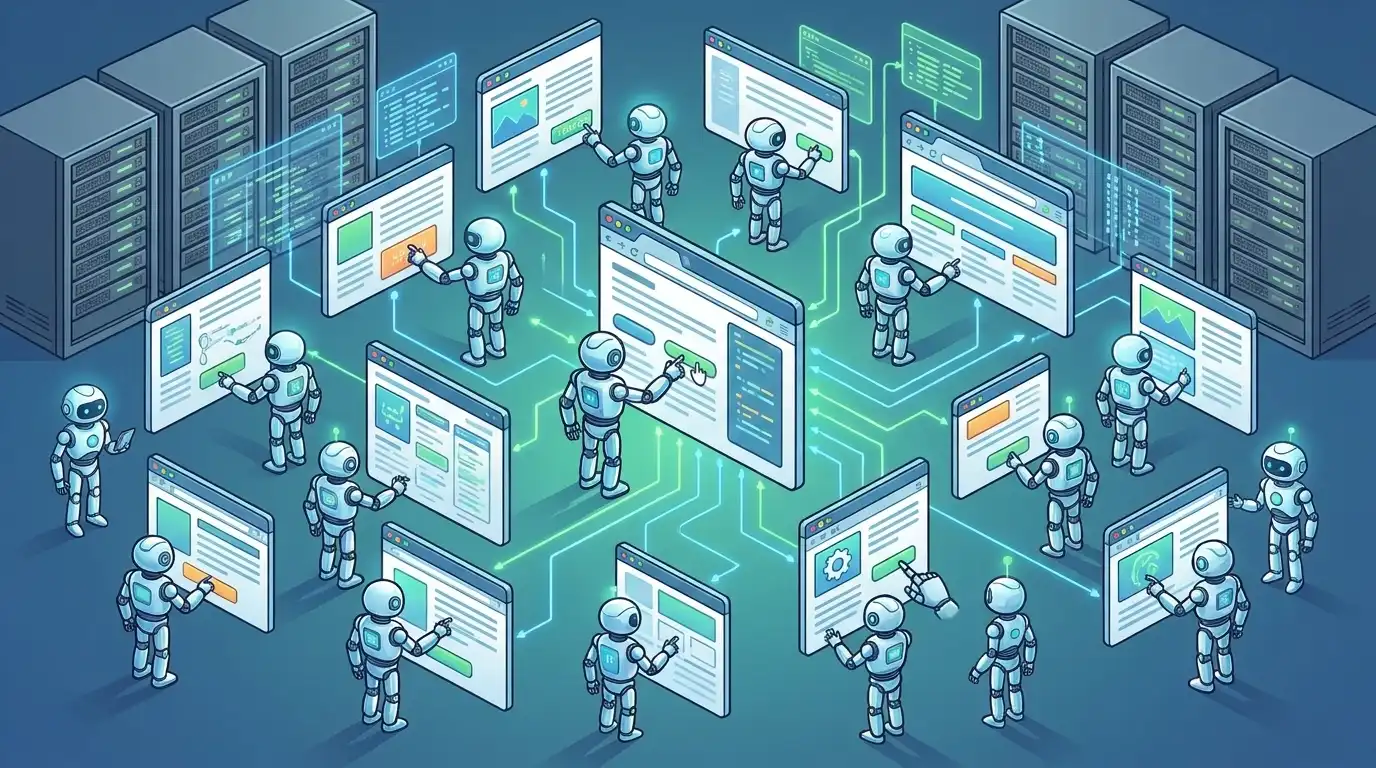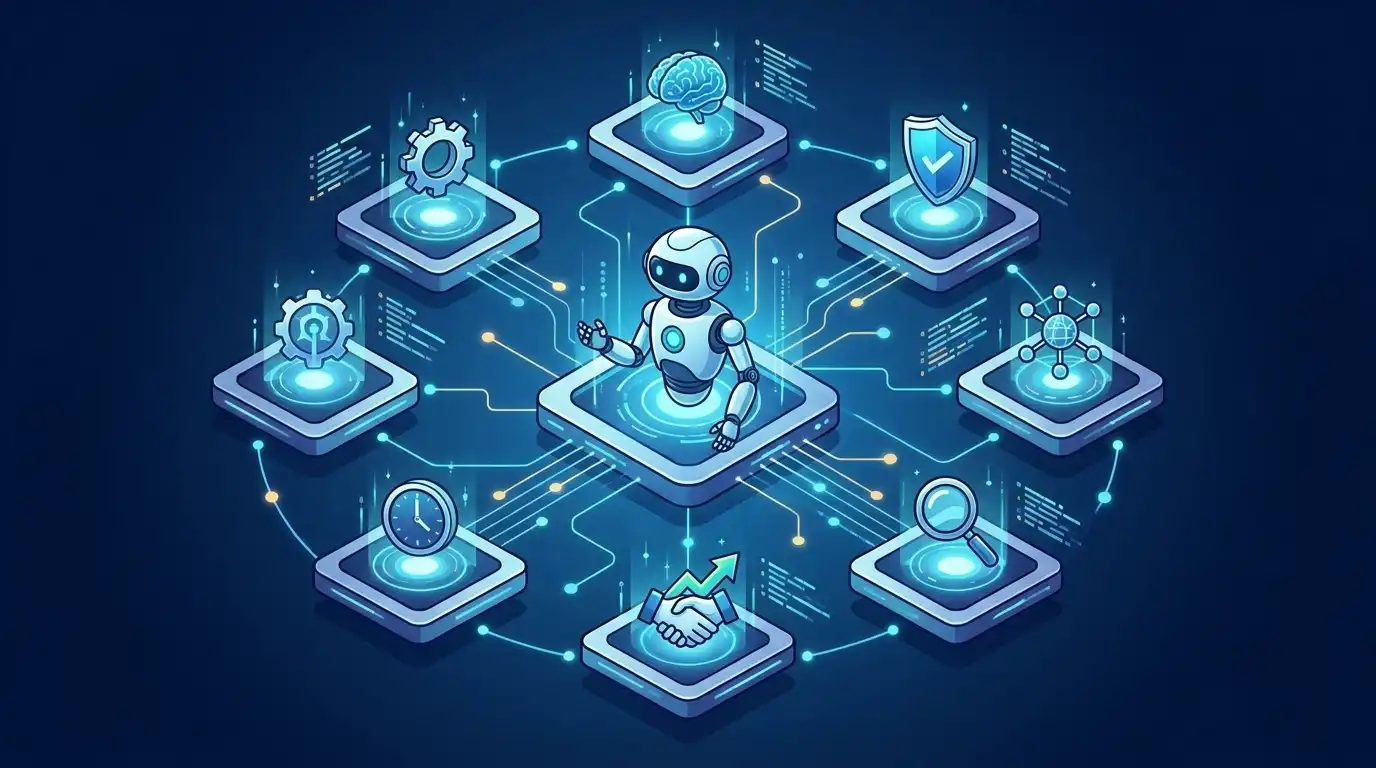
An agentic web is a website built as an autonomous agent: a system that holds the organization's knowledge and acts on it in real time, rather than a set of pages a visitor browses. The distinction is architectural, not cosmetic. A reactive assistant added to a landing page still sits on top of static content; an agentic web is designed as an agent from the ground up.
That design choice changes what a website can do. Its scope becomes the full acquisition path rather than isolated components, and it operates as a node other agents can read, not only a layout for human eyes. The eight capabilities below follow from that premise. Only the first concerns conversation; the other seven are infrastructure, and together they describe a category that does not yet exist as an accessible product.
1. Converses and Acts in Real Time
A conventional website displays the same content to everyone. An agentic web answers questions about the business from real knowledge, and operates in three modes: informing, guiding the visitor toward what they need, and capturing intent, with no page-hopping or forms.
The economic case is measurable. A human team takes an average of 47 hours to respond to a web lead, while responding within the first minute lifts conversion by 391% and 78% of buyers purchase from the first responder.
Capture happens without friction. Traditional forms convert between 1.7% and 3.1%, and 81% of people abandon a form after starting it. The agent requests name and email inside the dialogue, after the visitor has received value.
2. Personalizes by Intent, Not by Segment
The agent adapts each interaction to what the visitor states in natural language, not to a cookie or a predefined segment. It presents what the visitor needs already structured, replacing rigid pre-coded interfaces and the frontend maintenance they carry.
Someone asking about pricing receives a different response than someone asking about specifications or local availability. Market data places conversion improvement from AI personalization between 26% and 40%, though those figures describe segment-based personalization.
One-to-one conversation operates at a level a static website cannot attempt. The system reasons and decides using real organizational knowledge, reacting to each query and adapting continuously.
3. Operates as a Node Other Agents Can Read
As human browsing declines, the web shifts from a visual layout for people toward a machine-readable environment. An agentic web exposes clean, structured data that external agents, from other companies or from buyers, can query and transact with directly, under the protocols consolidating as standard.
The protocol layer is now mature enough to build on. The reference stack separates tool access from agent-to-agent coordination, with support confirmed across every major AI vendor.
- MCP monthly SDK downloads
- 97 million (March 2026)
- Official MCP registry servers
- near 10,000
- MCP governance
- Linux Foundation
- A2A protocol origin
- Google, April 2025
- Cross-vendor support
- Anthropic, OpenAI, Google, Microsoft
A site that offers no agent-readable layer cedes ground to one that lets a visiting agent resolve its query or close a transaction instantly. The MCP ecosystem passed 97 million monthly SDK downloads by March 2026, which places this integration within reach as ordinary infrastructure.
4. Stays in Sync With the Business
The agent connects to the CRM, the ERP, and internal AIs so answers reflect live availability and pricing, and every interaction feeds the systems the team already uses. It does not operate in isolation from the rest of the organization.
A captured lead enters the CRM with its conversation context. An availability or pricing query is answered with live ERP data rather than information updated months earlier.
💡 Expert note: If your catalog only renders for humans, connect the agent to the ERP so a pricing answer reflects today's stock, not a figure a content editor last touched a quarter ago.
This closes the long-standing gap between the storefront and operations. The agentic web reflects the current state of the business in real time.
5. Formulates Its Own Content Strategy
The system analyzes the offering, market position, competition, and metrics to propose titles, angles, target queries, and cadence. What previously required a strategist billing by the hour runs as compute capacity, at a frequency no human team could sustain.
It is not a static plan but a living mechanism that adapts to objectives and to the market environment. It designs and adjusts approaches autonomously toward the defined outcome within set timelines.
Supervision remains. An operator approves the strategy before execution, so direction stays under human control while the formulation cost approaches zero.
6. Updates and Improves Itself
With the content module active, the site feeds itself. It generates and publishes content optimized for search and AI answer engines, measures results in the funnel, and adjusts the next cycle based on what converted.
Direction is not set by a keyword planner. The agent turns the most frequent real visitor queries into indexable pages, so the site expands where there is demonstrated demand rather than assumed demand.
This matters because 68% of Google searches now end without a click, which makes being the cited answer, not the ranked link, the operative goal. AI Overviews now appear on more than 20% of queries and cut click-through by close to 60%.
7. Runs Specialized Apps on Top of the Agent
An agentic web is not a closed product but a platform on which vertical applications run, executed within the conversation. A diagnostic, a valuation report, a configurator: each is a capability the agent invokes when it detects the appropriate intent.
Each application attaches as a module via MCP without touching the core. Every solved vertical expands what the agent can do, and each new capability increases its value for the next deployment in the same sector.
Value accumulates on the platform rather than in any single piece. The visitor never leaves the dialogue to use any of these applications.
8. Measures the Whole Channel End to End
Because the entire chain lives in one architecture, so does the measurement. A single funnel covering impressions, clicks, engagement, leads, and sales replaces analytics plus a CRM plus a tracker plus a separate report.
This traces which content drives which conversation that produces which lead, in one funnel per site and in aggregate. It closes the loop without relying on probabilistic attribution across disconnected tools.
| Model | Traditional stack | Agentic web |
|---|---|---|
| Attribution | Probabilistic, across separate tools | Direct, content to conversation to lead |
| Data for agents | Human-readable layout only | Structured, machine-queryable |
| Measurement | Stitched reports | One funnel per site and in aggregate |
The value lies in the integration itself: one system where the traditional stack was a chain of loose parts.
Frequently Asked Questions
What is an agentic web?
An agentic web is a website designed as an autonomous AI agent rather than a set of pages to browse. It holds the organization's knowledge, responds and qualifies in real time, and operates as a node other agents can read.
How is an agentic web different from a website with an assistant added?
An added assistant is a reactive component on top of static pages. An agentic web is designed as an agent from the architecture up, covering the full acquisition path and exposing a machine-readable layer for other agents.
Why does an agentic web depend on AISEO?
Most informational queries now resolve before any click, with 68% of Google searches ending click-free in early 2026. An agentic web treats being the cited answer in ChatGPT, Perplexity, and Google AI Overviews as a foundational layer.
What role do MCP and A2A protocols play?
MCP standardizes how an agent accesses tools and data; A2A coordinates agent-to-agent interaction. Together they let an agentic web operate as a real node in the agent ecosystem, with MCP passing 97 million monthly SDK downloads by March 2026.
Does an agentic web replace the marketing team?
It augments rather than replaces. It absorbs repetitive qualification and content production so the team focuses on judgment, relationships, and cases the agent has already pre-assessed.