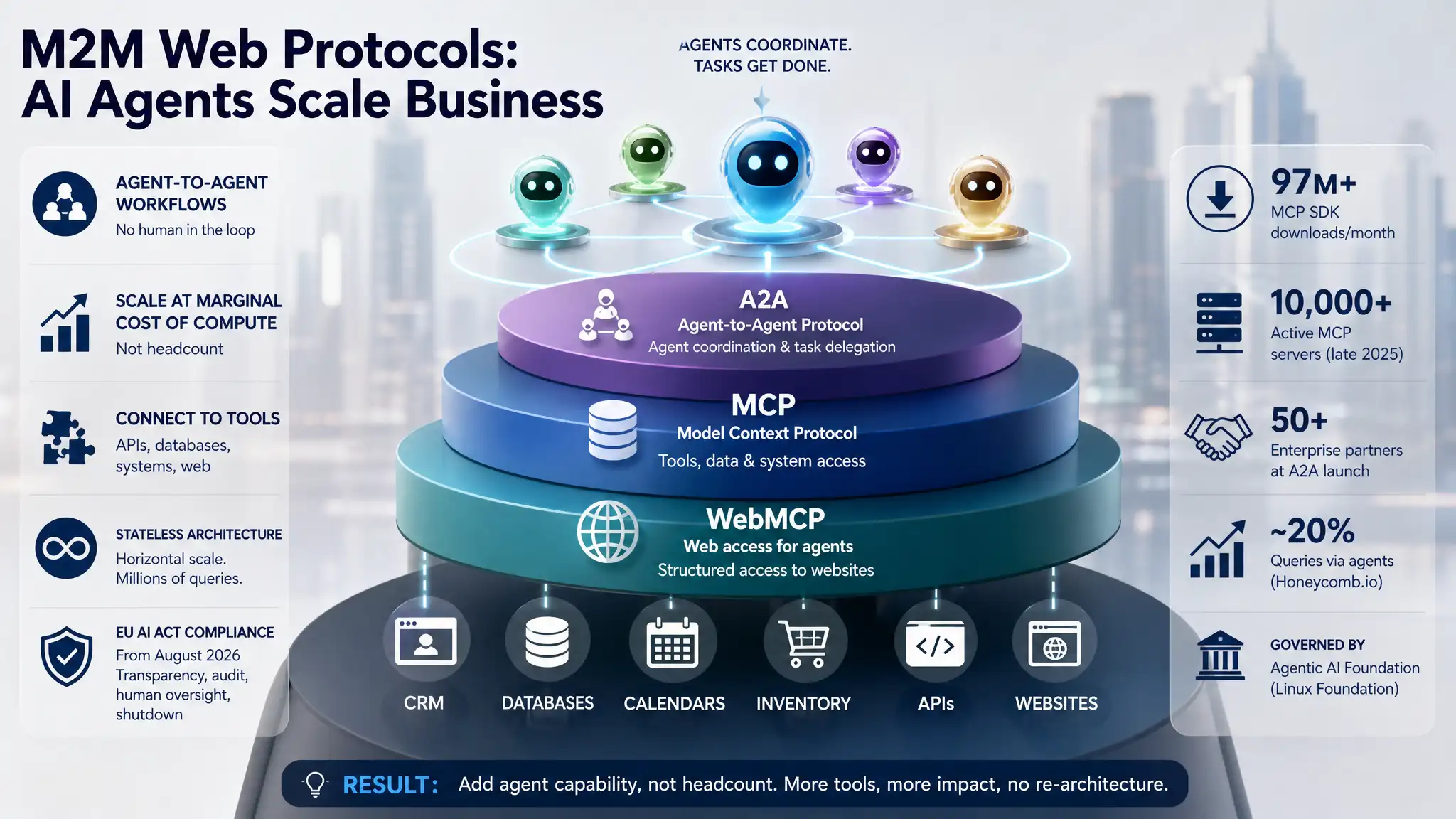
Machine-to-machine (M2M) web protocols, principally MCP and A2A, let autonomous AI agents connect to tools, share context, and delegate tasks across different systems without a human in the loop. A business scales on this stack by replacing the manual coordination that caps growth with agent-to-agent workflows that run at the marginal cost of compute, not headcount.
The Three-Layer Protocol Stack Powering Agent-to-Agent Business Operations
The infrastructure that makes M2M scaling possible is not a single standard but a layered stack, and each layer solves a distinct coordination problem.
MCP (Model Context Protocol), originally launched by Anthropic in November 2024 and now stewarded by the Agentic AI Foundation under the Linux Foundation, is the tool layer. It gives an agent a standardized way to call external tools, read databases, query APIs, and write outputs, without bespoke integrations for every service. A business with an MCP-enabled agent can connect it to its CRM, its inventory system, and its calendar in one consistent interface.
A2A (Agent-to-Agent Protocol), released by Google in April 2025, sits above MCP and handles the peer layer. Where MCP answers "how does this agent use a tool?", A2A answers "how does this agent talk to another agent?" It defines standardized message formats, capability discovery, and task delegation so that agents built by different vendors can coordinate work across enterprise systems in the same way that HTTP once let different servers exchange web pages.
WebMCP extends the stack to the open web, giving agents a structured interface to websites that were built for human browsers. Together, the three layers form a machine-addressable web on top of the human-readable one.
Why Statelessness Is the Mechanical Reason This Stack Scales
A session-based architecture ties each agent request to a specific server instance. That constraint breaks under load: you cannot simply add more servers when every conversation is pinned to one of them.
The July 2026 MCP specification resolved this by dropping session state from the protocol core entirely. Every request now carries its own context, so any server replica can handle it, with no shared state store required. Horizontal scaling becomes as straightforward as spinning up additional instances behind a standard HTTP load balancer. Google's own engineering teams adopted this approach to run MCP at millions of concurrent queries on Google Cloud, and the design is now the public standard.
The practical effect for a business: agent infrastructure stops being a bottleneck at scale. An agent handling ten conversations and an agent handling ten thousand conversations run on the same protocol, and capacity is added without re-architecting the coordination layer.
💡 Architecture note: Keep business logic in your MCP tools, not in transport state. A stateless MCP server that encodes all necessary context in each request message scales horizontally with zero coordination overhead and survives instance restarts without dropping in-flight work.
How Does a Business Actually Use These Protocols to Grow?
The scaling gain is not theoretical. It emerges in three concrete operational shifts.
Task delegation without human handoffs. A single orchestrating agent can decompose a business workflow, assign sub-tasks to specialist agents (a research agent, a writing agent, a scheduling agent), collect their outputs, and assemble the result. What previously required a project manager routing work between departments becomes an A2A exchange that completes in seconds.
System integration without custom code. Each new tool, database, or external API that joins the MCP registry becomes available to every MCP-compatible agent. A business that adds a new service provider to its stack does not write a custom integration for every agent that should use it: the MCP server for that provider is written once and reused everywhere.
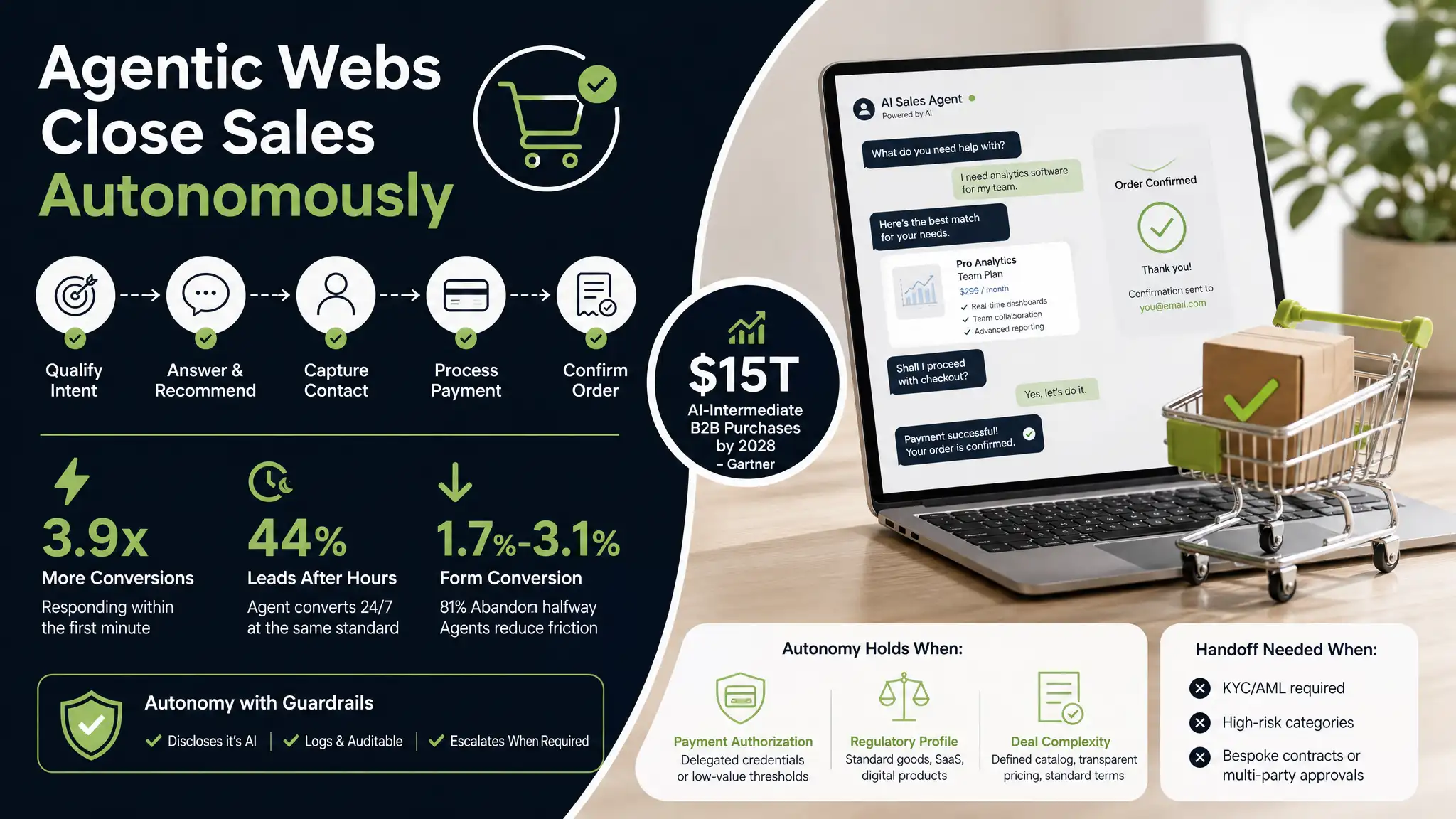
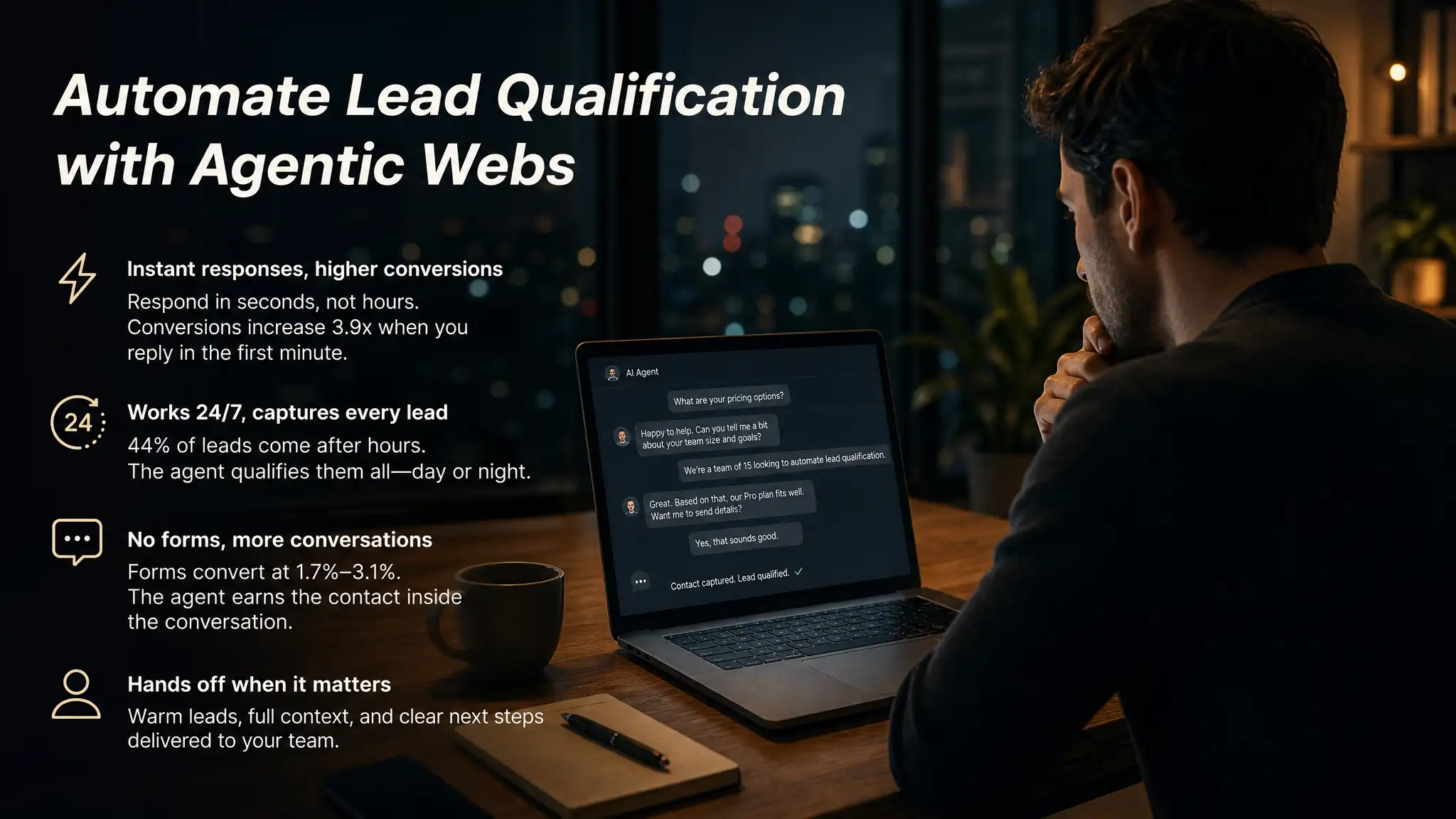
Continuous availability at marginal cost. An agent that qualifies leads, answers product questions, or processes customer requests operates at the cost of inference tokens, not staff hours. As query volume grows, compute cost scales smoothly; the agent does not call in sick, take vacations, or have a maximum simultaneous conversation limit.
What the Adoption Numbers Reveal about Timing
The window for first-mover advantage on this stack is measurable, not speculative. The MCP official registry reports that a platform like Honeycomb.io now routes nearly 20% of all monthly interactive queries through agents, a figure that was effectively zero eighteen months earlier.
At the protocol level, MCP has crossed 97 million monthly SDK downloads and 10,000 active public servers. A2A launched with over 50 enterprise partners and received a donation to the Linux Foundation within months, signaling institutional permanence rather than experimental status.
For most businesses, the window is: the infrastructure is proven but the adoption curve in most industry verticals has not yet closed. Competitors in legal services, professional services, real estate, healthcare administration, and retail still coordinate by hand or through simple rule-based automation. Building on M2M protocols now means compounding a lead before those verticals catch up.
The Compliance Layer that Comes with the Stack
Scaling on M2M protocols is not purely a technical question. Any autonomous agent that interacts with users in the European Union will fall under the EU AI Act obligations that come into full effect from August 2026, covering transparency (users must be informed they are interacting with AI), auditable technical documentation, human oversight mechanisms, and shutdown capability.
Businesses that design compliance into their agent architecture from the start avoid retrofit costs. Those that scale first and comply later face the retrofit at the worst possible moment: at volume.
The EU AI Act does not define harmonized technical standards for web agents yet. The practical implication is that platforms integrating compliance by architecture (disclosure triggers, audit logs, intervention hooks baked into the agent runtime) start with an advantage over those building compliance as an afterthought.
The Difference between a Chatbot and an M2M-Ready Agent
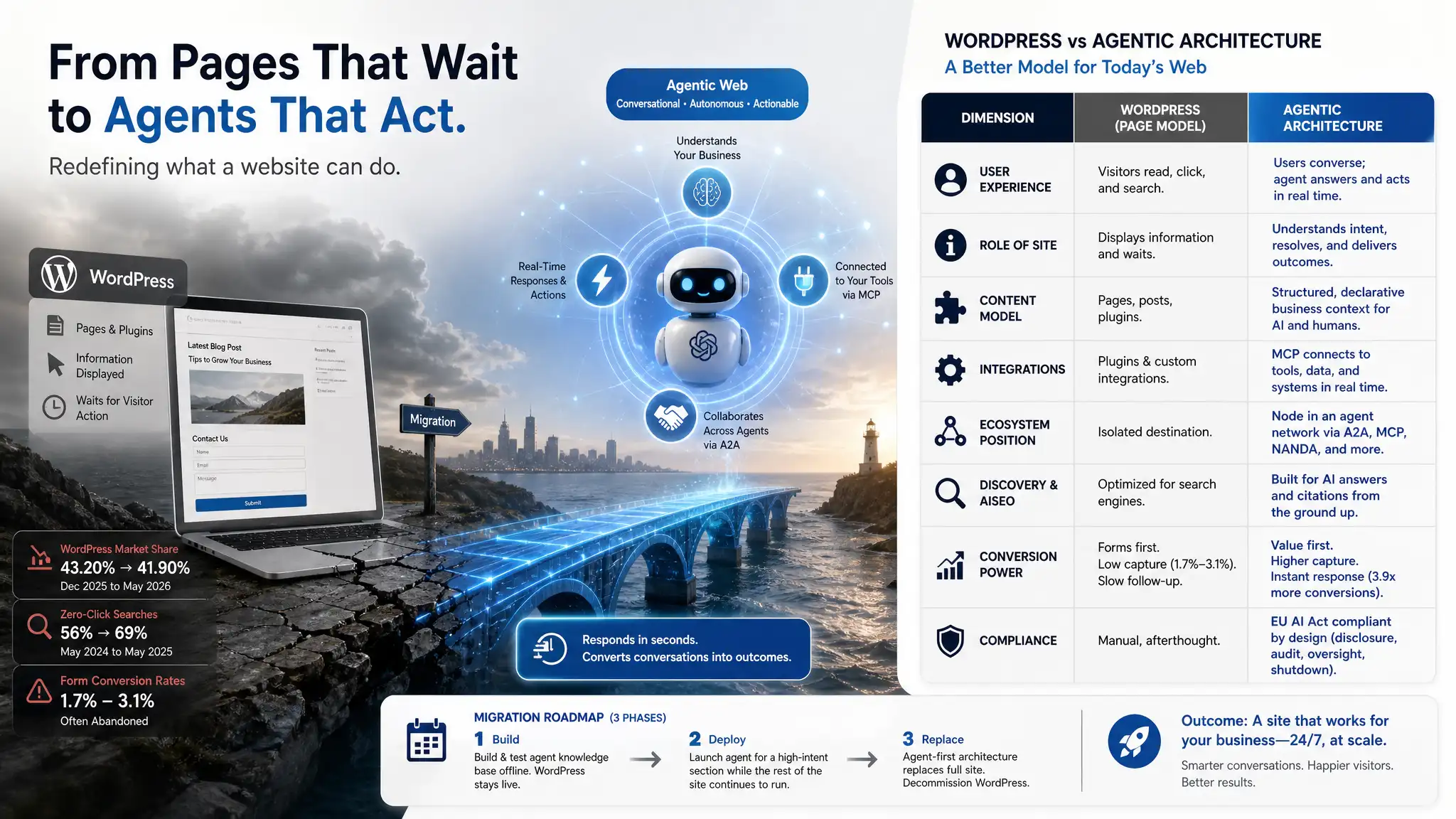
Most businesses that claim to be running "AI" on their websites are running a script-routing chatbot: a decision tree with an interface that looks conversational. It cannot call external tools, delegate subtasks, or be discovered and invoked by another agent.
An M2M-ready agent is architecturally different. It exposes an MCP server that other agents can call. It can receive A2A task delegations from orchestrators in other systems. It has access to real business data through tool calls, not hard-coded responses. And its behavior can be updated by changing the tool layer without touching the interface.
The distinction matters for scaling because a chatbot scales by adding more scripts; an agent scales by adding more tools, more capabilities, and more protocol integrations, all without a corresponding increase in development cost.
- Tool-access layer
- MCP (Model Context Protocol), stateless as of July 2026
- Agent-coordination layer
- A2A (Agent-to-Agent Protocol), April 2025
- Web-access layer
- WebMCP, W3C track, Chrome preview 2026
- Governance
- Agentic AI Foundation (Linux Foundation)
- Active MCP servers
- 10,000+ public as of late 2025
- Monthly MCP SDK downloads
- 97 million+
- Compliance trigger
- EU AI Act autonomous-agent obligations from August 2026
The three-layer stack is stable, governed, and compounding in adoption. A business that understands the mechanical reason it scales, plans its compliance architecture in parallel, and builds on open protocols rather than vendor lock-in is positioned to grow by adding agent capability rather than by adding headcount.