An agentic web can handle complete sales transactions without human intervention for the vast majority of commercial exchanges. The agent qualifies intent, answers product questions, recommends based on declared need, captures contact, and routes the payment, all within a single conversation. The conditions that require a human handoff are narrow but real, and knowing them is what separates a capable deployment from a broken promise.
What "Complete Transaction" Means in This Context
A complete sales transaction is not just a form submission or a lead capture. It covers the full cycle: intent detection, qualification, recommendation, objection handling, purchase authorization, and confirmation. An agentic web executes every step of that cycle autonomously, using the business's own knowledge base, catalogue, and pricing rules, no scripted menus, no handoff to a human to repeat the same answers.
The protocols that make this possible are now standardized. Anthropic's Model Context Protocol (MCP) lets an agent query any compliant server for tools and data. Google's Universal Commerce Protocol (UCP), announced at NRF in January 2026, enables AI agents to interact with merchant catalogues and complete purchases through a single open standard. Together with agent-to-agent coordination protocols like A2A, these form the infrastructure layer that turns a website into an operational transaction node, not just an information display.
Gartner predicts that AI agents will intermediate $15 trillion in B2B purchases by 2028, a figure that presupposes autonomous transaction capability is real and scaling, not theoretical.
The Conditions under Which Full Autonomy Holds
Full autonomy works reliably when three conditions are met simultaneously.
| Condition | When autonomy holds | When a handoff is needed |
|---|---|---|
| Payment authorization | Delegated credentials or low-value thresholds | KYC/AML verification required for the amount or jurisdiction |
| Regulatory profile | Standard consumer goods, SaaS, digital products | High-risk categories under financial, health, or product-liability law |
| Deal complexity | Defined catalogue, transparent pricing, standard terms | Bespoke contracts, multi-party approval chains, or custom scope |
The payment layer is where most current deployments hit their ceiling. Payment systems require extensive Know Your Customer and Anti-Money Laundering verification, including government-issued identification and physical addresses, with manual review processes often built specifically to prevent automated account creation and transactions, and even when verification is possible, it typically requires human intervention. New payment rails built for agents (such as stablecoin-settled micro-transactions and delegated authorization schemes) are narrowing this gap, but they are not yet universal.
💡 Deployment rule: Design the agent's autonomy boundary before launch, not after a compliance incident. Define the transaction ceiling, value, category, jurisdiction, at which the agent escalates to a human, and make that threshold part of the system prompt, not an afterthought.
What EU Law Requires from Autonomous Agents
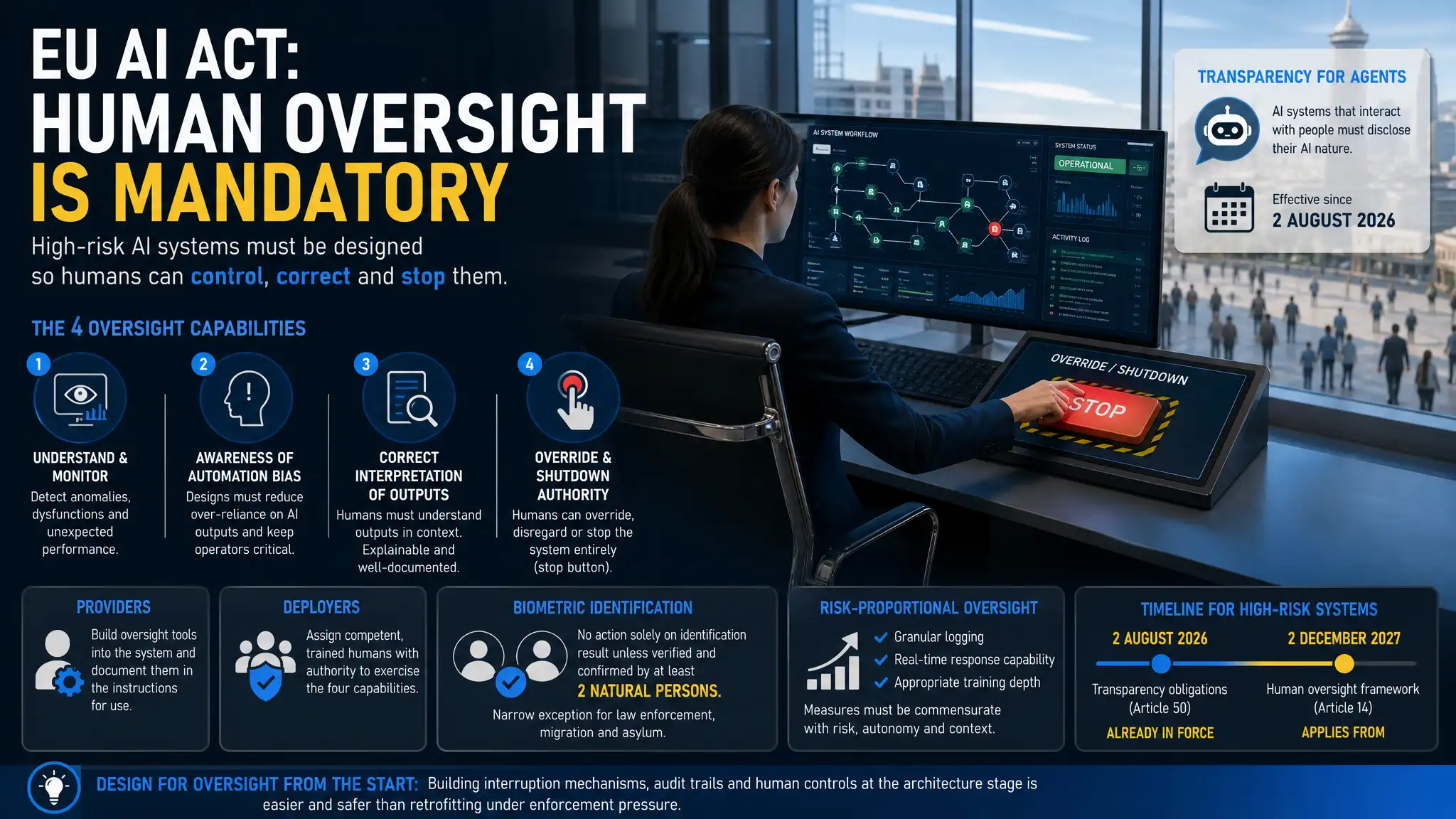
Autonomy does not mean operating without rules. Under the EU AI Act, Article 50, any AI system that interacts directly with users must identify itself as AI, and this obligation applies explicitly to agentic systems. The European Commission interprets the disclosure obligation broadly: whenever an AI system interacts directly with people it must identify itself as AI, and this explicitly includes agentic AI, systems that carry out tasks autonomously.
For higher-risk transaction contexts, Article 14 adds requirements for human oversight mechanisms, technical documentation, and auditable logging. Obligations for deployers of high-risk systems under Annex III become applicable from 2 August 2026. Harmonized technical standards are still being finalized, which means businesses that build compliance into architecture now hold a structural advantage over those improvising later.
The practical implication: an agentic web that transacts autonomously must be transparent about its nature at every interaction, must log what it decided and why, and must include a defined escalation path, not a fallback message, but a real handoff mechanism with full conversation context preserved.
Where the Agentic Web Consistently Outperforms Human Sales
The strongest case for autonomous transactions is not just that the agent can handle them, it is the economics of when it handles them. 58% of consumers prefer to use AI tools instead of traditional search engines in 2025, up from 25% in 2023, and 73% cite AI as their primary source of product research, which means buyers are already arriving pre-disposed to agent-led interactions.
The performance gap is sharpest in three areas:
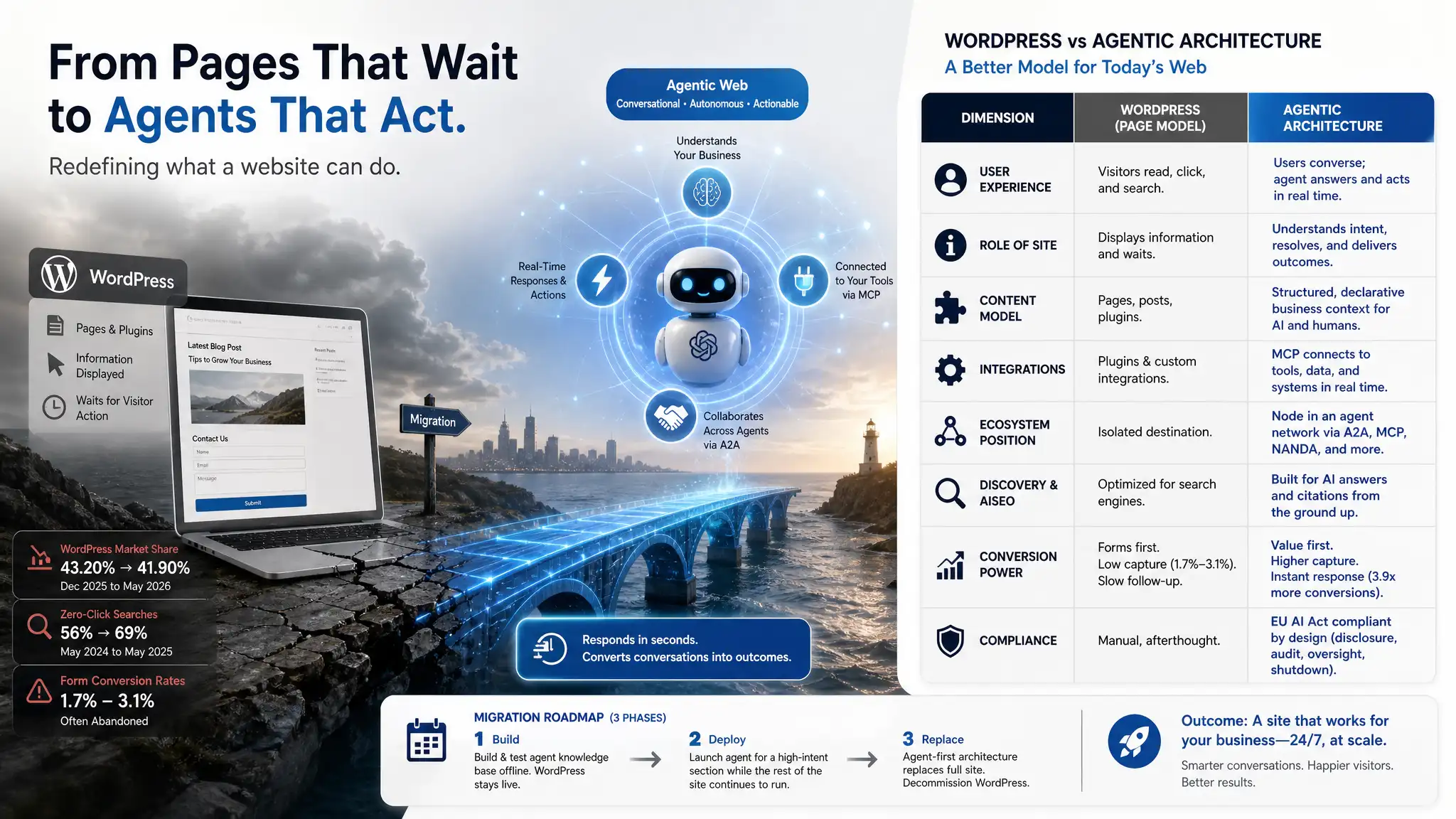
- Response time. A human sales team averages 47 hours to respond to a web lead. An agent responds the second intent appears. Responding within the first minute multiplies conversions by 3.9 times.
- After-hours coverage. 44% of leads arrive outside business hours. The agent qualifies and converts at 3 AM at the same standard as 10 AM, no answering machine, no lost opportunity.
- Friction at capture. Forms convert at 1.7% to 3.1%, with 81% abandoned halfway. The agent captures contact within conversation, after the visitor has already received value, not as a prerequisite toll.
None of those advantages require removing the human entirely from all transactions. They require placing the human only where the transaction genuinely needs them, and letting the agent own everything else.