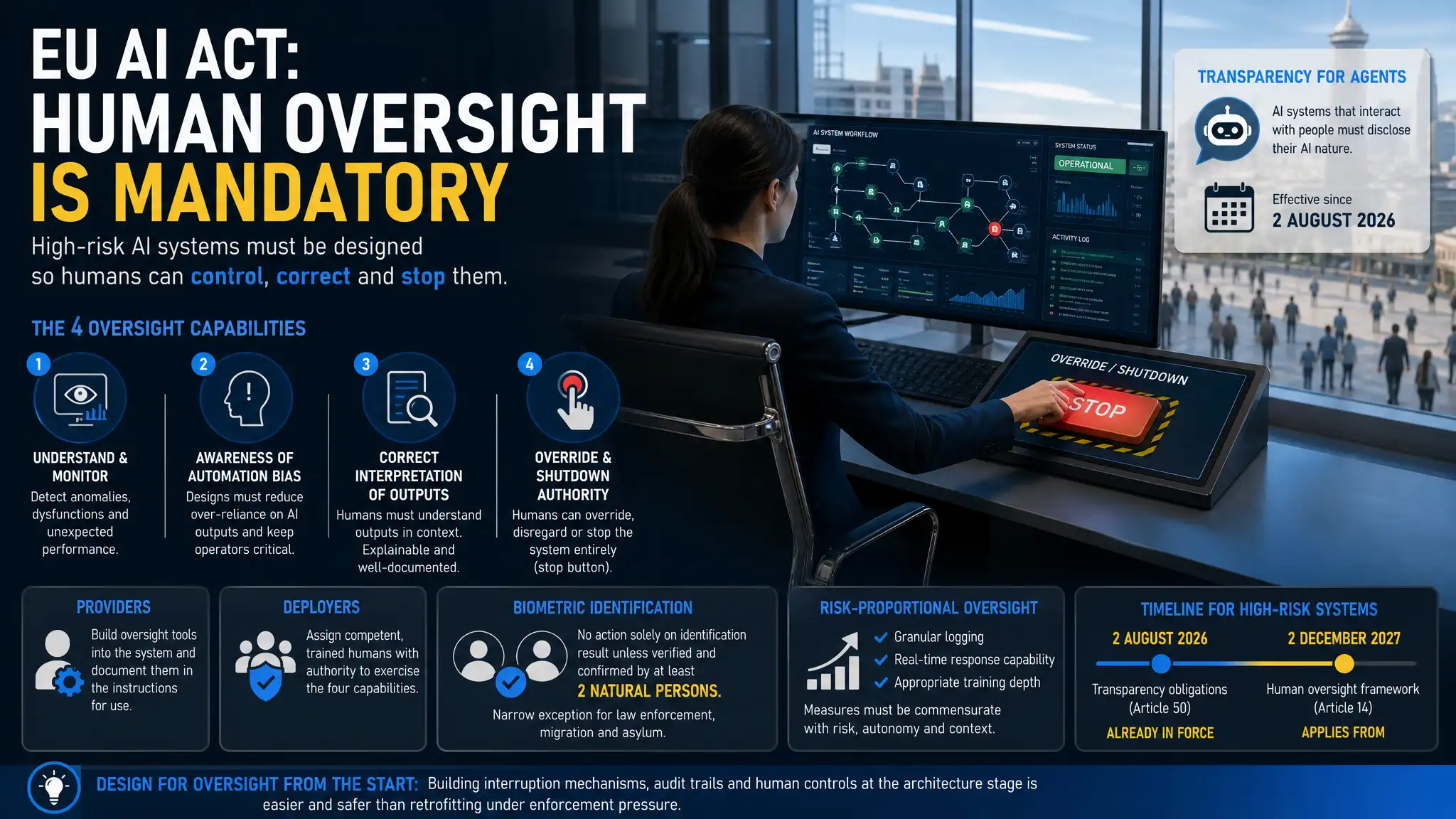
Article 14 of the EU AI Act requires every high-risk AI system to be designed so that natural persons can monitor its operation, interpret its outputs, override its decisions, and shut it down entirely. These obligations apply to providers and deployers of high-risk systems, with the standalone high-risk provisions now expected to apply from December 2027 following a legislative revision. Transparency rules for interactive AI agents took effect on 2 August 2026.
The Four Oversight Capabilities Article 14 Mandates
Article 14 of Regulation (EU) 2024/1689 is built around a single organizing principle: a natural person must be able to remain meaningfully in control of a high-risk AI system throughout its operational life. That principle translates into four specific capabilities that providers must build in, and that deployers must be able to exercise.
Understanding and monitoring is the first. Natural persons assigned oversight responsibility must be able to properly understand the system's capacities and limitations, and detect anomalies, dysfunctions, and unexpected performance as they occur. A system that operates as a black box, with no visibility into what it is doing or why, fails this test by design.
Awareness of automation bias is the second. Article 14(3)(b) explicitly names the tendency to over-rely on AI outputs, particularly in systems that produce recommendations for human decision-makers. Providers must design in mechanisms that keep operators actively critical of what the system produces, not passively accepting.
The third capability is correct interpretation of outputs. Oversight is not satisfied by someone watching a screen. The natural person must be able to understand what the output means in context, using whatever interpretation tools and methods the system supports. This implies documentation obligations: a system whose outputs cannot be explained cannot be overseen in the legal sense.
The fourth, and arguably most consequential, is override and shutdown authority. Article 14(3)(d) and (e) require that the system can be set aside, its outputs disregarded, and, where necessary, stopped entirely through a "stop button" or equivalent interruption procedure. For agentic systems that execute multi-step workflows autonomously, this requirement has direct architectural implications: every action pipeline must expose a halt mechanism.
How These Obligations Are Split between Providers and Deployers
The Act distributes oversight duties across the supply chain rather than placing them on a single party.
Providers (those who develop and place a system on the market) carry the upstream obligation. They must design and develop the system with the human-machine interface tools that make oversight physically possible. They must also document those oversight measures within the instructions for use, as required by Article 13(3)(d), so that deployers know how to exercise the controls that have been built in.
Deployers (those who operate the system under their own authority) carry the downstream obligation. They must assign oversight to natural persons with the necessary competence, training, and authority to exercise the four capabilities above. Assigning oversight to someone without the skills to interpret the system's outputs does not satisfy the requirement.
This split matters especially for businesses deploying third-party AI systems: buying a compliant model does not transfer the deployer's oversight obligations. The deployer must independently verify that oversight measures are in place and that the people exercising them are genuinely capable of doing so.
Biometric Identification Systems: A Stricter Sub-Rule
For high-risk AI systems used for biometric identification of natural persons (a category listed at point 1(a) of Annex III), Article 14(5) adds a requirement that no action or decision may be taken solely on the basis of the identification result unless it has been separately verified and confirmed by at least two natural persons with the necessary competence, training, and authority.
This two-person confirmation rule reflects the severity of errors in identification contexts, where a false positive can have immediate consequences for the person identified. A narrow exception applies in law enforcement, migration, and asylum contexts where the dual-verification requirement is considered disproportionate under Union or national law.
How Oversight Connects to the Transparency Obligation for Agents
Article 50 of the Act, which requires AI systems that interact directly with natural persons to disclose their AI nature, took effect on 2 August 2026, as confirmed by Cooley's analysis of the August 2026 implementation. The disclosure obligation applies to providers of interactive systems, including conversational AI agents, unless it is already obvious to a reasonable person that they are interacting with AI.
Article 14 and Article 50 are therefore related but separate requirements. Transparency tells the user they are dealing with an AI system. Human oversight ensures a human can step in, correct, or stop that system. An agent can satisfy the disclosure obligation while failing the oversight one if its architecture provides no real mechanism for interruption or correction.
For agentic systems operating across multi-agent architectures, analysis from Stibbe's transparency series notes that the transparency obligation extends to indirect interaction with natural persons, and that providers who cannot predict at design time whether their agent will interact with a human must design the disclosure in from the outset.
What "Commensurate" Actually Means in Practice
Article 14(3) qualifies the oversight measures as "commensurate with the risks, the level of autonomy and the context of use" of the system. This proportionality principle does real work: a high-risk system making consequential recommendations to a professional carries heavier oversight requirements than one operating in a lower-stakes deployment context.
In practice, proportionality affects three design decisions. First, the granularity of logging: systems with higher autonomy need more detailed records of what actions were taken and why, so that a human reviewer can reconstruct the decision chain. Second, the response time required of oversight personnel: faster-acting systems require oversight mechanisms that can interrupt in real time, not retrospectively. Third, the depth of training required: deployers operating more autonomous systems must ensure that the natural persons exercising oversight have correspondingly deeper competence.
💡 Design for oversight from the start: Retrofitting interruption mechanisms and audit trails onto an already-deployed agentic system is substantially harder than building them in at the architecture stage. The proportionality requirement is not a licence to build a minimal system and add controls later.
The Revised Application Timeline for High-Risk Systems
The original deadline of 2 August 2026 for standalone Annex III high-risk AI systems has shifted. Deeploy's regulatory tracker notes that the Digital Omnibus provisional agreement moved this deadline to 2 December 2027 for standalone systems. Systems embedded in products already regulated by sector-specific legislation under Annex I face a later deadline of 2 August 2028.
The transparency obligations of Article 50, however, applied from 2 August 2026 on the original schedule. Any interactive AI agent operating in the EU today is already subject to the disclosure requirement; the human oversight framework of Article 14 follows when the full high-risk provisions enter force.
This sequencing creates a window in which the easiest obligation to check (disclosure) is live, while the more demanding architectural requirements (oversight mechanisms, technical documentation, risk management systems) are still in preparation. Building compliant infrastructure during that window is substantially easier than retrofitting it under enforcement pressure.